
In Praise of Identities: A Philosopher's Argument for Who We Are By Alioune Badara NDIAYE

Updated: 9 hours ago

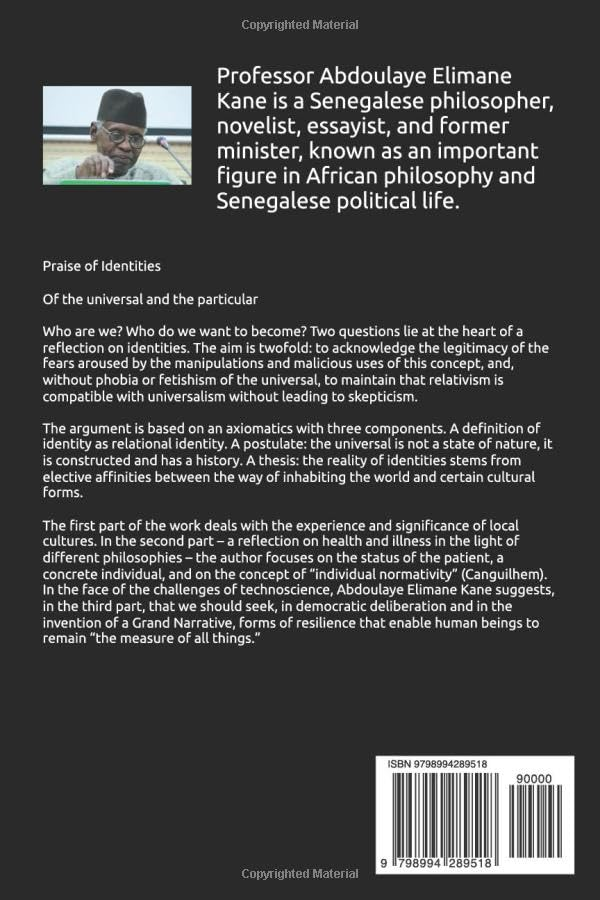
There are questions that a civilization keeps returning to because it has never quite answered them. Who are we? is one. What do we share with those who are not us? is another. For much of the last century, these two questions have been set against each other, as though a strong answer to the first could only come at the cost of the second. Prof. Abdoulaye Elimane Kane has spent a lifetime arguing otherwise. His book, In Praise of Identities: Of the Universal and the Particular, is the summation of that argument — patient, rigorous, and urgently needed.
A Life Rooted in Thought and Governance
Abdoulaye Elimane Kane is not a figure who moved through the world at a remove from its affairs. Born in Senegal, he came of age intellectually at one of Africa's great centers of learning, Cheikh Anta Diop University in Dakar — named for the Senegalese historian and anthropologist who spent his own career insisting that Africa's intellectual contributions had been systematically written out of the human story. At UCAD, Kane found his calling in philosophy, and he rose to become Professor Emeritus, one of the institution's most distinguished voices.
But thought, for him, was never separate from action. Between 1993 and 2000, he served in the government of Senegal: first as Minister ofCommunication, then as Minister of Culture. These were not honorary appointments. They were years in which he shaped policy — over the press, over the arts, over the public institutions through which a society remembers and transmits itself. A philosopher in the cabinet is a rare thing. Kane used the position to do what philosophers are supposed to do: to ask what a thing is for, and to act on the answer.
In April 2025, the Senegalese Association of Publishers recognized him with one of its highest distinctions: the title of Grand Champion of Letters and Culture. The honor is not ceremonial. It names someone whose life's work has genuinely enlarged the republic of letters — in Senegal, in Africa, and across the African diaspora.

The Book and Its Argument
In Praise of Identities arrives at a moment when its central question has become impossible to avoid. Identity — cultural, ethnic, national, linguistic - is the hinge on which some of the most consequential political conflicts of our era turn. In much of the public conversation, identity is treated as a problem: as tribalism in need of correction, as particularism in conflict with the demands of a shared humanity, as the enemy of cosmopolitanism.
Kane will not accept this framing. His book is a philosophical defense of identity — not as a wall, but as a foundation. The particular, he argues, is not the opposite of the universal. It is its condition. You cannot arrive at a genuine universalism by first erasing the specific histories, languages, and cultural inheritances that make human beings who they are. That path does not lead to the universal. It leads only to the erasure of the particular — which is to say, to a universalism that is, on inspection, the imposition of one particular perspective dressed in universal clothes.
The argument is developed with care. Kane draws on the long tradition of African philosophy, on the French philosophical tradition in which he was trained, and on the lived experience of peoples who have had to fight, repeatedly, for the right to be recognized as both distinctly themselves and fully human. The book does not flatten the difficulty of the question. It sits with it. Identity can indeed become a weapon — a ground for exclusion, for hierarchy, for violence. Kane does not pretend otherwise. But the answer to identity wielded badly is not the abolition of identity. It is a more rigorous, more generous understanding of what identity is.
What he offers is a philosophical vision in which relativism and universalism are not enemies. Cultural difference — real, substantive, irreducible difference — is the starting point for a conversation between peoples, not an obstacle to it. Solidarity does not require sameness. The universal emerges from the encounter of particulars, not from their suppression.
The African Diaspora and the Stakes of the Argument
For those of us living in the diaspora, this argument is not abstract. It is the argument of our lives.
The African and African-descended communities of the Americas have been told, in one form or another, that their identities are supplementary — added ornament to a universal norm, acceptable when kept private and quiet, dangerous when asserted too loudly or in the wrong company. The history of that pressure is long. It runs from the literal destruction of African cultural memory during the period of enslavement to the more contemporary insistence that racial or ethnic identity is a distraction from a shared citizenship or a shared humanity.
Kane's book speaks into this history with precision. He does not speak from the outside. As a philosopher schooled in the tradition of Cheikh Anta Diop — who spent his career arguing that the intellectual achievements of ancient Egypt were African achievements, and that the erasure of that fact had served specific political purposes — Kane works from within a tradition that has always understood the politics of recognition. The question of whether African identity is legitimate, whether it has philosophical standing, whether it can be held with pride and without apology: these are not theoretical puzzles in this tradition. They are matters of record and of justice.
In Praise of Identities extends that tradition into the present moment. It gives us a vocabulary — philosophically grounded, historically informed — for making the case that who we are is not incidental to what we stand for. That the particular path through which each of us arrives at the human conversation is part of what we bring to it, and is worth defending.
Why This Book, Why Now
Cultural identity is under pressure everywhere. The temptation, in response to that pressure, is either to retreat into a defensive particularism that closes the door to dialogue, or to abandon the particular altogether in a rush toward an abstract universalism that dissolves real difference into rhetoric. Kane's book refuses both exits. It holds the tension — and turns it into an argument.
That is what good philosophy does. It does not make the hard questions easier. It makes the difficulty productive.
For readers of AFRIG MAG, the book is an intellectual companion for the questions we live with: about what it means to carry African identity in the diaspora, about how to speak across the divide of difference without pretending the divide is not there, about what we owe each other precisely because we are not all the same. These are not questions that will be resolved in a single evening at a monument in lower Manhattan. But there are few better places — and few better books — to begin.
In Praise of Identities: Of the Universal and the Particular is published by AFRIG MAG.


Comments